The next chapter: DWG’s predictions for the digital workplace in 2027
Each year, when I sit down to develop DWG’s predictions, I look for a connecting thread behind the individual signals emerging from member conversations, research insights, benchmarking data and wider industry developments.
This year’s task proved surprisingly difficult. It was not because the signals were weak. If anything, they were stronger than ever.
Organizations are accelerating AI adoption while bringing governance to the executive agenda. At the same time, renewed attention to knowledge management and workforce agility is prompting leaders to reconsider the employee experience. Across these developments, trust and accountability are becoming more urgent.
On the surface, these may appear to be separate topics. However, the more I explored them, it became so clear they are interconnected.
AI is changing how knowledge is generated and consumed, which in turn shapes decision-making and trust. That trust influences adoption and ultimately determines whether the organization can learn, adapt and respond effectively.
Over the past two decades, the digital workplace has evolved through several distinct phases. Its earliest forms focused on access, communication and connectivity. Later generations emphasized digital destinations, collaboration, productivity and employee experience. With the arrival of generative AI in the enterprise, AI quickly became the dominant lens through which its future was viewed.
These developments point towards a new phase of maturity, in which the digital workplace strengthens organizational capability and confidence. What was once viewed as a collection of technology, people and process initiatives is now becoming an integrated system. That integration brings a new set of questions to the foreground.
Digital workplace leaders must now consider how this integrated system should work in practice.
- How do we preserve critical knowledge as expertise becomes more fluid?
- How do we improve decision-making when information volumes are increasing exponentially?
- How do we balance automation with trust and accountability?
- How do we make effective use of both human and artificial intelligence?
- How do we remain adaptable in an environment where disruption is a constant?
Together, these questions define the central challenge – building an integrated system that connects knowledge, learning, trust, judgement and action so the organization can adapt with greater assurance and impact.
What 2026 taught us
Before looking ahead, it is worth pausing to consider what the past year revealed. Rather than simply validating earlier predictions, 2026 exposed the conditions that will determine whether AI-enabled work really creates lasting value. The case for a new thesis – that the digital workplace is becoming the cognitive infrastructure through which organizations sense change, coordinate action and adapt with confidence – has been strengthened.
The digital workplace has evolved from the standard hub for accessing tools, content and services into a critical testbed for whether an organization is ready to operate in AI-enabled ways.
The enduring lessons relating to human-centred design, co-creation, AI readiness, trusted knowledge and technology embedded in the flow of work were all familiar, but what changed was the consequence of these learnings. AI became an organizational mirror, revealing how unprepared many organizations are to govern content, workflows, capability and decision-making at scale.
One lesson stands out: AI readiness increasingly equates to content readiness. As AI enters the flow of work, enterprise content must be reliable enough to support it. AI rarely repairs weaknesses in how that content is managed; it makes them visible.
In 2026, the priority was to move AI from experimentation towards practical, scaled use. The challenge for 2027 is more ambitious – redesigning the work system so people and intelligent machines can sense, decide, coordinate and adapt together. That challenge provides the foundation for DWG’s 2027 thesis.
For a deeper stocktake of the 2026 predictions, see the Diary of a She-E-O entry entitled: So, how are DWG’s 2026 predictions holding up?
DWG’s 2027 thesis: The digital workplace becomes the infrastructure for adaptive work
Deeper use of AI is now a given. The differentiator will be whether organizations can redesign the work system so human and machine intelligence adapt together with trust and accountability. That will depend on an operating environment in which knowledge, governance and judgement reinforce continuous learning.
The digital workplace cannot own every part of this system; essential responsibilities remain distributed across the organization but its distinctive role is to integrate the experiences through which employees access what they need to do their work well.
This thesis points towards a deeper conclusion – that the digital workplace is becoming the cognitive infrastructure for adaptive work. The four shifts that follow show how that transition is taking shape and provide the structure for the 10 predictions.
Four shifts shaping 2027
The 10 predictions can be read through four connected shifts in how the digital workplace creates value. Together, they show how work, intelligence and adaptability are being redesigned.
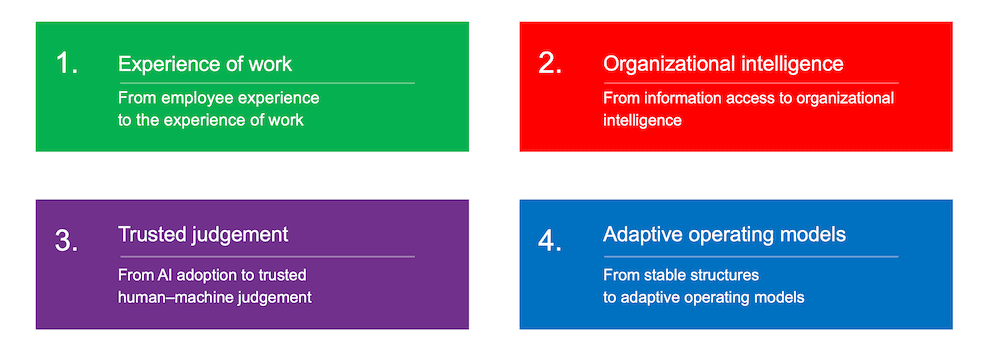
These shifts are interconnected and provide the roadmap for the 10 predictions. Read sequentially, the predictions trace the wider transition towards a digital workplace that helps the organization sense, decide, coordinate and adapt with confidence and coherence.
The 10 predictions for 2027
The sequence begins with the experience and orchestration of work, moves through organizational intelligence and trusted human–machine judgement, and concludes with the adaptive operating models needed to sustain continuous change.
Read on to find out more…