Beyond AI pilots: Why organizations must become hyperadaptive
DWG Book Review Digest
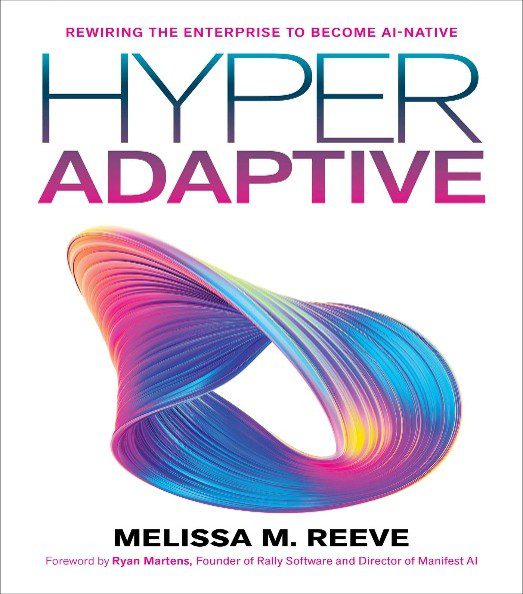
There are moments in a technology cycle when the conversation needs to pivot. Not incrementally, not cautiously, but decisively. Hyperadaptive: Rewiring the enterprise to become AI-native is one of those inflection-point books.
Melissa Reeve does not set out to write another guide to artificial intelligence. In fact, she actively rejects that approach. Instead, she reframes the challenge entirely: this is not about AI adoption as a technology programme but about organizational evolution at scale.
That distinction matters more than most leaders realize.
A book that calls time on ‘pilot purgatory’
Within Digital Workplace Group (DWG) circles, we frequently hear a familiar refrain: Organizations are experimenting enthusiastically with AI, yet they are struggling to move beyond pockets of success.
Reeve gives language to that frustration and, more importantly, a path through it. Her diagnosis is both stark and refreshingly honest. The majority of AI initiatives falter not because of the tools themselves but because they collide with entrenched culture, legacy roles and operating models that were never designed for continuous, machine-speed adaptation. In other words, we are trying to graft exponential capability onto linear organizations.
Hyperadaptive challenges this head-on. It makes a compelling case that the real work of AI transformation is systemic. It lives in governance, decision rights, funding models and ultimately in how work flows across the enterprise.
From experimentation to orchestration
One of the most valuable contributions of the book is its structured progression from early experimentation to what Reeve describes as full organizational orchestration.
This is not presented as a leap, but as a staged journey. Leaders are guided through a maturity arc that starts with foundational understanding and moves toward organizations that can sense, respond and evolve in real time.
This idea of “sense and respond” feels particularly resonant. In the digital workplace community, we have long talked about employee experience as something that must be both frictionless and adaptive. Reeve extends that thinking to the enterprise itself. The organization becomes the experience.
There is also an important realism woven throughout. This is not a book that promises a rapid transformation. Reeve leans into what she calls the “messy middle” – that uncomfortable collision between old structures and new capabilities where most programmes stall. That level of candour, in and of itself, is a differentiator.
The human dimension is not a side note
If there is a single thread that elevates Hyperadaptive, it is the insistence that people are not a constraint to be managed but the core system to be redesigned.
Reeve repeatedly reinforces that successful AI transformation depends primarily on culture, learning and organizational design rather than on algorithms alone.
This aligns strongly with what we see across DWG’s membership. The organizations making meaningful progress are those investing as much in psychological safety, skills and decision-making clarity as they are in technology.
The book’s case studies, spanning organizations such as Nike, Toyota and Moderna, bring this to life in practical terms. They also illustrate what it looks like when companies move beyond isolated innovation towards systemic reinvention.
A blueprint; not a manifesto
It would be easy for a book like this to remain conceptual. Reeve avoids that trap.
What she offers instead is a blueprint. Not rigid, not universal, but grounded. Leaders are given concrete ways to rethink roles, governance and resource allocation as AI reshapes the nature of work itself.
There is also a subtle but important shift in how success is framed. Hyperadaptive encourages leaders to design organizations for continuous learning and adaptation instead of focusing solely on efficiency and automation. That is a materially different ambition.
Why this book matters now
Timing is everything. We are entering a phase when AI is moving from novelty to necessity. The early adopters have proven the art of the possible. The next wave must see the art of the scalable. Hyperadaptive lands precisely at that junction.
For those willing to engage with that reality, this book provides both a vocabulary and a pathway forward. It also challenges leaders to confront an uncomfortable truth: most transformation efforts will fail if the organization itself does not change.
Final reflection
This is not a book you read once and shelve. It is one you return to as your organization progresses along its own maturity curve.
For CEOs and senior leaders, the question it poses is deceptively simple: Are you embedding AI into your organization, or are you reshaping your organization to thrive with AI? Only one of those paths leads to hyperadaptivity.
And as Reeve makes abundantly clear, in a world defined by accelerating change, the ability to continuously sense, respond and evolve is no longer a competitive advantage. It is fast becoming the price of admission.
Related resources
As part of launching her virtual book tour, I had the honour and privilege of speaking with Melissa about these themes and more on the Digital Workplace Impact podcast. I hope you will give it a listen alongside poring through an important read.
Related downloads
(DWG members can download full versions of all research via the member extranet)
Read more about Artificial intelligence and automation in our Knowledge Hub.
Categorised in: Artificial intelligence and automation