Knowledge management
An essential guide for knowledge managers and digital workplace practitioners
Knowledge is one of an organization’s most valuable assets and how it is used can significantly impact performance and innovation. Knowledge management (KM) provides a structured way to turn individual expertise into collective intelligence, improving decision making, collaboration and continuous learning.
This guide covers the key principles, benefits and best practices of KM, showing how connecting people to knowledge and using tools like AI can preserve critical insights, boost productivity and create a more agile, knowledge-driven organization.

What is knowledge management?
Knowledge management (KM) is a structured framework for creating, sharing, accessing and reusing knowledge, built on four key pillars: people, processes, technology and content. It focuses on shaping the work environment to motivate and empower individuals to contribute ideas, share expertise and learn from one another, ensuring that valuable knowledge is captured and effectively utilized.
Key pillars of knowledge management
People: Employees are both sources and users of knowledge; their collaboration and expertise drive successful KM.
Processes: Standardized structures help streamline the creation, sharing and storage of knowledge, making information retrieval efficient.
Technology: Platforms and tools enable knowledge documentation, organization, search and delivery at scale.
Content: Well-organized, relevant and up-to-date information forms the foundation for all KM activities.
Although KM has been recognized as a discipline for more than 30 years, it remains relatively specialized. Originally rooted in knowledge-intensive sectors such as professional services and law firms, knowledge management is now gaining wider relevance across industries, particularly in technology and software services, where leveraging organizational knowledge has become critical for innovation, efficiency and competitive advantage.
A knowledge asset can be an area of valuable knowledge or a competence that an organization holds. This knowledge can be tacit (held in the heads of experienced individuals) or explicit (documented, e.g. in manuals or guidance). Knowledge assets can also be embedded in an organization’s structures, job descriptions, workflows and procedures. Well-managed knowledge can be a valuable asset.
Types of knowledge
Knowledge within an organization comes in many forms, each playing a vital role in how work is done and value is created. Broadly, it can be understood through three key types, each with their own characteristics and uses.
Tacit knowledge: Deep expertise, intuition, know-how and unwritten insights, often held by experienced employees.
Explicit knowledge: Codified information, such as manuals, documents and reference materials.
Embedded knowledge: Practices, workflows or routines ingrained in day-to-day organizational processes.
In simple terms, knowledge management is and has always been, about connecting people to people, people to content and content to people. But what does this mean – and why does it matter?

How to connect people to knowledge
An important outcome of knowledge management is to get the right knowledge to the right people at the right time. The purpose is to avoid duplication, retain knowledge within the organization, easily share and find knowledge assets, identify and develop expertise, save time and transfer knowledge to spark new ideas.
In order to successfully connect people to knowledge, focus on three key principles: connecting people to people, connecting people to content and connecting content to people, ensuring that expertise, information and insights flow seamlessly throughout the organization.
Connecting people to people
Organizations are essentially networks of individuals, each carrying valuable knowledge and experience. Much of what an organization ‘knows’ is informal, context-rich and embedded in the people themselves, often referred to as tacit knowledge. This knowledge is deeply rooted in social interaction, anecdotes and reflections. Stories 'from the front line' often convey insights more effectively than formal documentation. For example, engineers may find the stories shared on a building site far more instructive than written manuals.
These social networks act as conduits for knowledge. Connections are built through trust, relationships and a sense of belonging, which encourage people to share their expertise. Often, tacit knowledge resides with ‘silent experts’, who might not volunteer their insights unless they feel welcomed and valued within the network. Sharing knowledge also requires effort; documenting experiences or lessons learned is cognitively demanding and rarely done without motivation. However, when individuals perceive the value (whether through professional recognition, a sense of identity or reciprocal learning), they are far more willing to invest time and energy in passing knowledge along.
Knowledge management practices and tools connect people and facilitate the sharing of knowledge. This is done in a variety of ways:
Communities of practice (CoPs)
Communities of practice are formal networks where individuals with a common goal collaborate to identify solutions and share good practice and ideas. They are crucial for tacit knowledge transfer and enable members to deepen their knowledge by participating in the community. They are well suited to connecting people to people, as they allow members to locate experts through the community. The ability of community members to identify and link with others in a specific area of practice is a key dimension of a healthy CoP.
Expertise locators
Expertise locators are directories or platforms that point knowledge seekers to experts in specific subjects or knowledge areas. This facilitates connecting expertise across an organization – and making it searchable. Expertise locators directly address the fundamental knowledge management challenge of finding the right person with the right knowledge when needed.
Mentoring and coaching
Many KM programmes include structured initiatives designed to transfer experience from seasoned employees to newcomers or peers. Coaching and mentoring are both effective tools for knowledge transfer, although their mechanisms differ.
Mentoring is directly aligned with knowledge transfer, particularly from experienced individuals to novices. Coaching, while not directly transferring knowledge from the coach, facilitates learning and insights. A coach provides a safe space for the ‘coachee’ to evoke awareness, explore possible blocks in their thinking and ask questions that lead to them generating their own insights and solutions.
Peer assists and knowledge exchanges
These are structured KM techniques used to facilitate knowledge transfer and collaborative learning within organizations. They are particularly useful when a team is about to start a new project or address a fresh challenge and wants to learn from others who have relevant experience. The goal is to share insights, lessons learned and practical advice before the new team starts work. The approach enables team members to tap into the collective knowledge of others who have ‘been there’ and helps to break down silos by connecting people across the organization and fostering a culture of learning and openness. Such sessions often lead to ongoing informal networks that support continuous knowledge sharing.
When organizations facilitate these connections, they create an environment where learning and knowledge transfer are organic, socially embedded processes. This ground-up approach builds trust, motivation and a vibrant culture of learning.
Connecting people to content
While social interactions are powerful, knowledge must be documented to retain organizational memory and improve organizational performance. However, content is only valuable in context, so finding the right information at the right moment is critical.
Knowledge should be documented in a shareable and reusable format and stored in an appropriate repository for ease of retrieval. Knowledge management creates the structures and processes to do this through:
Content management
Content management supports connecting people to content by making it easier to locate and retrieve relevant documents, guides and other resources. Proper tagging and categorization ensure that content can be found through intuitive search and filtering. Classifying knowledge with meaningful metadata makes high-value, reusable knowledge stand out from the noise.
Through content personalization and access control, employees can easily find content tailored to their role, department or project, reducing noise and increasing relevance. Key information should be easy to find, with intuitive navigation and homepages.
Effective search and retrieval
Employees must be able to locate and access the right content quickly. Advanced search features (e.g. semantic search, AI-powered recommendations) help users find what they need fast, even if they don’t know exactly what to search for.
By connecting people to content, organizations minimize wasted time searching and reduce the risk of errors or duplicated effort. Employees gain confidence that the information they need is accurate, up-to-date and easy to find.
Connecting content to people
Knowledge is powerful when it is delivered precisely when and where it is needed, tailored to the individual and the situation. Some refer to this as knowledge delivery at the ‘teachable moment’, i.e. an individual is most receptive to learning at the point of challenge when facing a problem (or opportunity).1
Knowledge management can facilitate surfacing relevant content based on an employee’s role, responsibilities and knowledge needs. This involves identifying, organizing and sharing valuable knowledge from a variety of sources, effectively curating knowledge to ensure access to the most relevant and current content.
In practice, this can look like:
Targeted delivery
KM systems surface resources based on users’ profiles or current tasks, meaning that knowledge ‘finds’ the person, not just the other way around. This ensures knowledge is immediately useful and actionable.
Timeliness
Knowledge is surfaced proactively before it is searched for through notifications, embedded help or smart recommendations.
Relevancy
Effective curation ensures that what’s highlighted is credible, fresh and closely matches the user’s workflow or challenge. For example, new employees or those changing roles get curated content that will accelerate their learning curve and reduce dependency on others.
This approach recognizes that in a dynamic business environment, context is everything. When organizations connect content to people in smart, tailored ways, they boost learning, accelerate problem solving and foster adaptability.
Synthesis: the knowledge cycle
These three connections: people to people, people to content, content to people – are interdependent and are inherent in the knowledge cycle.
Knowledge management incorporates a continuous process:
- Create: New knowledge emerges from collaboration and problem solving.
- Capture: Valuable insights, lessons and experiences are recorded and stored for future use.
- Curate: Knowledge is organized, filtered and maintained to ensure relevance, accuracy and accessibility.
- Share: Knowledge is disseminated – via conversation, mentoring or digital platform.
- Apply: Employees use this knowledge to address challenges and innovate.
- Learn and improve: Feedback closes the loop, refining and expanding the knowledge base.
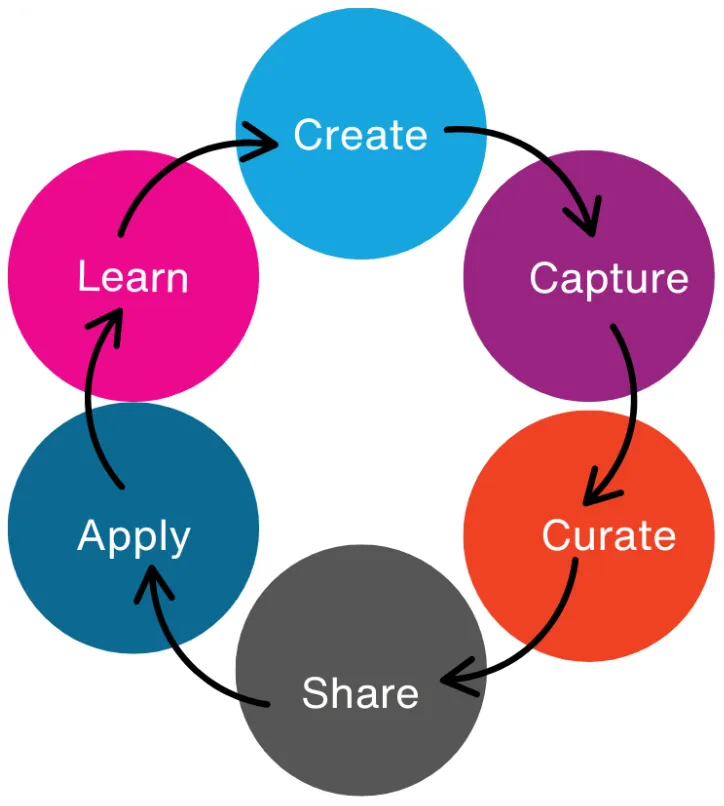 The knowledge cycle
 In this continuous cycle, organizations convert raw experience into intellectual capital, ensuring that knowledge isn’t accidentally lost, deliberately hoarded or left to languish in forgotten folders. Instead, it becomes a vibrant, dynamic resource that contributes to the organization’s purpose and growth.

What are the benefits of knowledge management?
Implementing knowledge management brings significant advantages to organizations. It improves efficiency by reducing the time employees spend searching for information and prevents duplication of work. By making expertise and insights easily accessible, teams can make faster, better-informed decisions, respond more effectively to challenges and enhance overall productivity.
Knowledge management also fosters innovation and collaboration. By encouraging knowledge sharing, organizations tap into collective intelligence, enabling employees to build on each other’s ideas and develop creative solutions. Additionally, it helps preserve critical organizational knowledge, minimizing the impact of staff turnover and ensuring continuity. Over time, these benefits contribute to stronger customer service, improved competitiveness and sustained organizational growth.
Common knowledge management challenges
In practice, it can be very challenging to embed an effective knowledge management programme into an organization. Technically, it can be time-consuming and complex and culturally, there are behavioural change-related barriers.
Some of these challenges include:
Capturing tacit knowledge
Unwritten and intangible expertise is hard to document. The risk of knowledge loss becomes greater as employees leave and retire. Many organizations are now talking about the ‘silver tsunami’, i.e. the demographic shift resulting from baby boomers reaching retirement age. This signifies a potential loss of experience and institutional knowledge.
Resistance to change
It is notoriously difficult to incentivize employees to change their habits. Most people are comfortable with the status quo. They may view KM as extra work or even actively refuse to share their knowledge for fear of diminishing their value to the organization.
Lack of engagement
The resistance to change can lead to a lack of engagement with the KM programme. This results in low participation in KM activities and a withering of the knowledge base. Repositories grow cluttered with outdated, redundant or irrelevant content.
Invisible benefits
Knowledge management is a long game. It can take time to see the benefits and value. This can be a challenge for those trying to embed KM, as it is difficult to quickly demonstrate a return on investment.
Inappropriate or outdated tools and technology
Often, technology is deployed without the requisite user research, design and testing. This usually results in outdated, overly complex or non-integrated platforms, which deter adoption.
To avoid, mitigate and address these challenges, there are some common best practices for organizations to follow when implementing knowledge management.

Knowledge management best practices
1.Develop a clear knowledge management strategy and action plan
A critical best practice is to develop a KM strategy aligned with an organization's strategic priorities and overall business objectives. This ensures that the KM programme demonstrates tangible business value through increased revenue, faster cycle times, cost savings or improved quality. Common KM goals include enabling better and faster decision making, making it easy to find relevant information, reusing ideas and expertise, avoiding redundant efforts and mistakes, accelerating delivery to customers and stimulating innovation and growth.
A knowledge audit can be particularly useful before developing a strategy or planning new KM investments, helping to identify areas of high knowledge potential and providing a baseline for ongoing assessment.
2. Establish clear KM leadership, governance and operating model
Successful KM programmes are typically driven by dedicated KM staff and a supporting operating model, including sponsorship from leadership. This involves preparing the organization for KM delivery, considering KM roles, skills and organizational structures. Knowledge champions can play an important role in consistently distributing KM messages and activities across an organization.
To avoid silos and problems with content duplication and findability, it is important to standardize processes for knowledge capture, sharing, storage and transfer. This involves defining ‘what goes where’ and ‘what to use when’ to streamline information flow and reduce redundant efforts. It also includes standardizing knowledge acquisition and storage processes.
Knowledge content should be effectively curated to ensure it is easily accessible and findable. This may involve maintaining an organization-wide taxonomy for shared language and integrating software and workflows.
3. Foster a knowledge-sharing culture and manage change
Company culture significantly shapes staff behaviour and attitudes towards capturing and sharing knowledge. A knowledge-sharing culture empowers individuals, supports informal networking and encourages knowledge sharing across organizational and geographic boundaries. Barriers to collaboration, such as unconnected reward systems, lack of common vision and internal competition, should be addressed through formal communication and change management initiatives.
Organizations should encourage collaboration and transparency and foster an environment where individuals feel comfortable sharing ideas and learning from both successes and failures. This includes promoting a culture of continuous improvement and empowering staff to share knowledge.
Embedding KM successfully requires not only technical solutions but also cultural and behavioural transformation.
Communication is crucial for KM adoption. Craft a compelling story about why KM matters – linking to organizational goals like innovation, efficiency and employee empowerment. Use omnichannel messaging to reach different audiences and tailor messages to roles and departments.
To enable change and increase chances of adoption, start small with pilot groups to test KM tools and processes. Use their feedback to refine before scaling. Integrate KM into onboarding and offer role-specific training. Include ‘how to find, share and apply knowledge’ in learning paths.
4. Invest in appropriate tools and technology
While technology alone cannot catalyse KM, it can significantly enhance knowledge sharing and collaboration. Organizations are seeing the benefit of delivering content in enterprise and web-based applications. Key considerations for knowledge platforms and bases include:
- Taxonomy and classification: Proper taxonomies, data classification and metadata are essential for effective information management and successful enterprise search.
- User-centric design: Solutions should address business challenges rather than forcing challenges to fit existing solutions. Building and implementing solutions in conjunction with users and testing with pilot groups can provide valuable feedback on tool suitability.
- Enterprise search: Getting search right is challenging, even with the best systems, as it relies on good information management, tagging, metadata and keywords.
- Social technologies: The application of social technologies to operational and mission-critical business functions, often referred to as ‘social business’, can enhance KM by enabling distributed social interaction, collaboration and content creation.
Select, design and implement platforms that support knowledge management objectives, ensuring streamlined tools and technology for knowledge sharing and collaboration.
5. Measure success
Define and track key performance indicators (KPIs) and metrics to measure the success of KM initiatives.
Common KPIs include:
- Knowledge reuse rate: Measures how often existing knowledge assets are reused across projects or departments.
- Search success rate: Indicates the percentage of successful searches where users find relevant information quickly.
- Participation in communities of practice: Tracks the number of active members and contributions within CoPs.
- Time saved through KM: Estimates the reduction in time spent searching for information or solving problems due to KM systems.
- Employee satisfaction with KM tools: Gauges user satisfaction through surveys and feedback mechanisms regarding KM platforms and tools.
These metrics help demonstrate the tangible value of KM efforts and guide continuous improvement.
In essence, KM best practices move beyond simply storing documents to nurturing a culture of knowledge sharing, supported by strategic planning, effective operating models and appropriate technology, all with a clear focus on delivering measurable business value.

Conclusion: The importance of knowledge management
In today’s fast-moving, information-rich world, knowledge is one of an organization’s most valuable assets. Effective knowledge management ensures that expertise, information and insights flow seamlessly to the people who need them, when they need them. By connecting individuals to the right knowledge, organizations can accelerate decision-making, improve collaboration and foster innovation.
The benefits are clear, but so are the challenges: without the right structures, culture and tools, knowledge can easily become siloed or lost. That's why adopting proven best practices such as developing a clear KM strategy and action plan, fostering a knowledge-sharing culture and investing in appropriate tools and technology is essential.
Ultimately, knowledge management is not just about storing information; it’s about cultivating an environment where knowledge is continuously created, shared and applied. Organizations that prioritize it will be better equipped to adapt, compete and thrive in an ever-changing landscape.
Unlock the full potential of your organization’s knowledge with DWG's expert knowledge management consulting services. We help businesses capture, organize and share critical insights, connecting people with the information and expertise they need to innovate, make smarter decisions and stay ahead of the competition. From implementing best practices and creating effective KM frameworks to integrating cutting-edge AI solutions, our team ensures your knowledge assets are leveraged to their maximum value. Partner with us to transform the way your organization learns, collaborates and grows. Contact us to find out more

Essential knowledge management resources
- View all knowledge management articles
- Podcast: The resurrection of Knowledge Management in the digital workplace
- Why you can’t manage knowledge – and what to do instead
- Podcast: A bold dream for the future of knowledge workers
- What digital workplace practitioners can learn from Knowledge Management
- Report: Knowledge Management lessons for digital workplace practitioners
- Podcast: Can Knowledge Management save the world?
Access locked content 

Our members enjoy unlimited access to a library of resources, reports and many more exclusive benefits. If you’d like to view more digital workplace articles like these, please consider becoming a member!