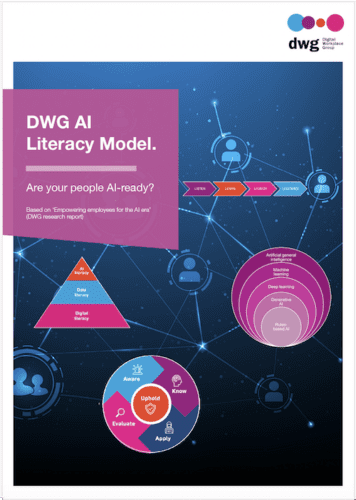
Training the change agility muscle to thrive in disruptive times

How do you respond to change? Perhaps it depends on the type of change, the context. Perhaps on the role you’re playing within it.
As a digital workplace practitioner, which changes excite you with possibility? Which fill you with dread and concern? And how fast does it feel change is coming at you and your team in these days? Do you feel capable to respond and anticipate what’s coming? Or does it feel like a deluge?
DWG’s latest research report, Change agility for digital workplace teams: How to thrive in disruptive times (available to download in full and for free) draws on a blend of leading change theories and practical insights from award-winning digital workplace case studies, to guide digital workplace teams through becoming change agile.
Because while change itself may be a given, in these rapid, urgent times, some of the best responses start not with speed, but with pause.
The shift from change management to change agility
These are VUCA times, as we so often hear now. Volatile, uncertain, complex and ambiguous.
The pace of technology change can leave us breathless. And that’s before economic, societal, ecological, political instability are thrown in for good measure.
Digital workplace leaders and practitioners sit at a knotty intersection within their organizations: a buffer between their colleagues and the hype cycles of emergent technology, while also impacting and amplifying organizational culture, change, strategy.
Our received wisdom of the old change management models – tightly tuned for episodic change – can’t cope with the constant flux that is now our reality. Whether because of external events (such as the COVID-19 pandemic or the sudden explosion of AI capability) or internal ones (such as budget cuts or organizational changes), new muscles and capabilities need to be nurtured that allow digital workplace practitioners, the digital workplace itself, as well as an organization’s people and structures, to adapt and flex.
And so, change agility. Rather than a replacement for change management, change agility is about our readiness to sense, respond – and even anticipate – an ever-changing landscape.
Can we be adaptive? Can we sense opportunity? Experiment? Act without full information? Empower others?
Whereas change management is a set plan, guiding through the knowns of a project, change agility comprises our own personal, relational and strategic capabilities that guide us through the surprises and shocks that come our way, giving us the confidence that we have the resilience to respond.

The dimensions and enablers of change agility
The research paper identifies three dimensions which indicate that an individual, group and organization have change agility. While the paper goes into these in full, they take in:
- Personal change agility: flexibility; speed; adaptability; proactiveness; resilience; continuous learning; tolerance of ambiguity.
- Relational change agility: collaboration; empowerment; psychological safety; responsiveness.
- Strategic change agility: systems thinking; alignment; sensing; innovative experimentation; consistent action.
Beneath these lie an array of enablers that are more likely to foster change agility across the three spheres:
- Leadership and culture: empathetic leadership; transparent communication; culture of experimentation.
- Strategy and governance: agile governance; data-informed; external insight.
- People and capability: digital and AI literacy; champion networks; structured learning pathways; reward and recognition.
- Technology and infrastructure: integrated digital platforms; AI and automation; feedback and analytics.
- Ways of working: micro-change practices; cross-functional collaboration; scenario planning and foresight.
When present, these can support an individual, a team and the wider organization to be more responsive, proactive and even generative in managing the changes the 21st century has in store for us.
How to get started
How we respond to change can be deeply personal. Those responses don’t happen in a vacuum; they comprise our whole lived experiences of change, our beliefs, stories about change, beliefs about our own resilience and capabilities – of those around us and our organization.
Becoming more adept at change agility is like training a muscle. For some, it will already be well developed and used – ready to spring into action at any given moment. For others, it may feel like a muscle they didn’t even know they had, which needs gentle exercises first before being ready for more intense activity.
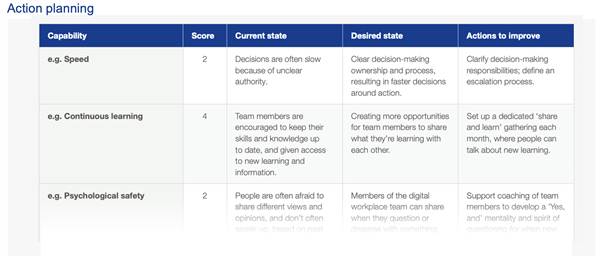
Getting started at the individual, team or organizational level can be as simple as a self-diagnostic across the different change agility dimensions, to identify current strengths and room for growth.
From there, an action plan can be developed, prioritizing areas and identifying the next simple steps to start to strengthen that muscle.
Leaning into uncertainty
Poet Alex Elle has a beautiful, short piece called rebirth:
there will be moments when
you will bloom fully and then
wilt, only to be born again.
if we can learn anything from
flowers it is that resilience is born
even when we feel like we are
dying.
It takes courage to look within the eyes of disruption, change, uncertainty, and to lean in and say ‘yes’ to your chosen path through it.
DWG’s CEO, Nancy Goebel, often speaks of shifting from ‘worrier’ to ‘warrior’; to be able to feel the worries, the anxieties that are inevitable, and then transmute them into action.
Alongside this, philosopher, poet and professor of psychology, Báyò Akómoláfé, often cites the Yoruba wisdom: “The times are urgent; let us slow down.”
The urge amongst change can be to either shrink and do nothing, to turn away and not look – freeze, or flight – or go fast, go bigger, puff ourselves up – fight.
Sometimes, these can be the correct paths.
But what effective change agile digital workplace teams and practitioners often realise is that there’s a beat, a pause, before those choices. A moment of intentionally slowing down just enough to be able to take everything in that is available, weigh up the options and then acting.
Download the free research
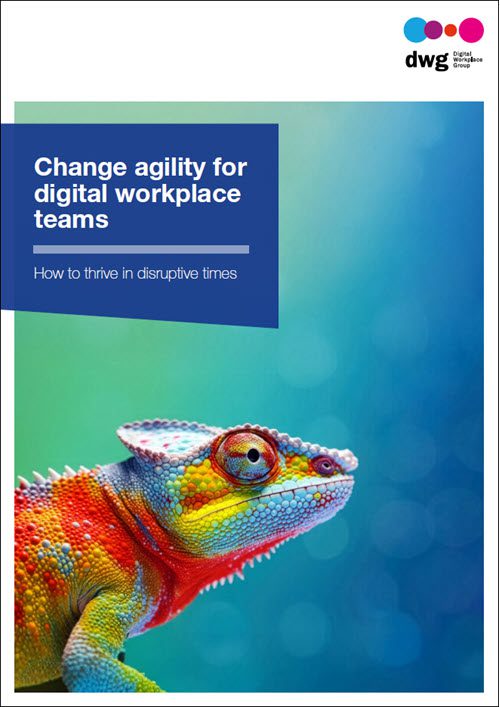
To understand how change-agile you and your organization are, download the full research report for free.
🔒 DWG members can access their copy of the research via the extranet. 🔒
For more digital workplace resources, DWG members have full access to this research, as well as exclusive articles, events, peer insights and a Research Library of 100+ reports covering key areas such as digital employee experience, AI readiness, strategy and governance, knowledge management, digital workplace transformation, change management, and more.
Contact us to learn how to gain access to this library via DWG membership.
Categorised in: Change management and adoption