Today’s ponderable: Why do some EXP platform implementations turn from brilliant to brittle at the end of the first year?
Dear Diary,
I have been sitting with this question for a while. Partly because it keeps turning up in member conversations, and partly because, in our field, we have a habit of celebrating the go‑live and then quietly tiptoeing away from the messy, instructive year that typically follows.
And here is what I have come to believe: A year after implementing an employee experience platform, teams rarely regret the platform itself. They regret the assumptions they smuggled in with it:
- They assumed the platform would create clarity.
- They assumed the platform would simplify the channel landscape.
- They assumed the platform would fix search.
- They assumed the platform would pull fragmented experiences into a cohesive whole.
In other words, they assumed technology would do leadership’s job. That assumption does not survive contact with reality!
So, in true DWG style, I decided to do what we always do when a pattern becomes undeniable: turn it into a tool. A diagnostic. A scorecard. Something leaders can use to replace post-implementation regret with post-implementation intent.
This is that tool.
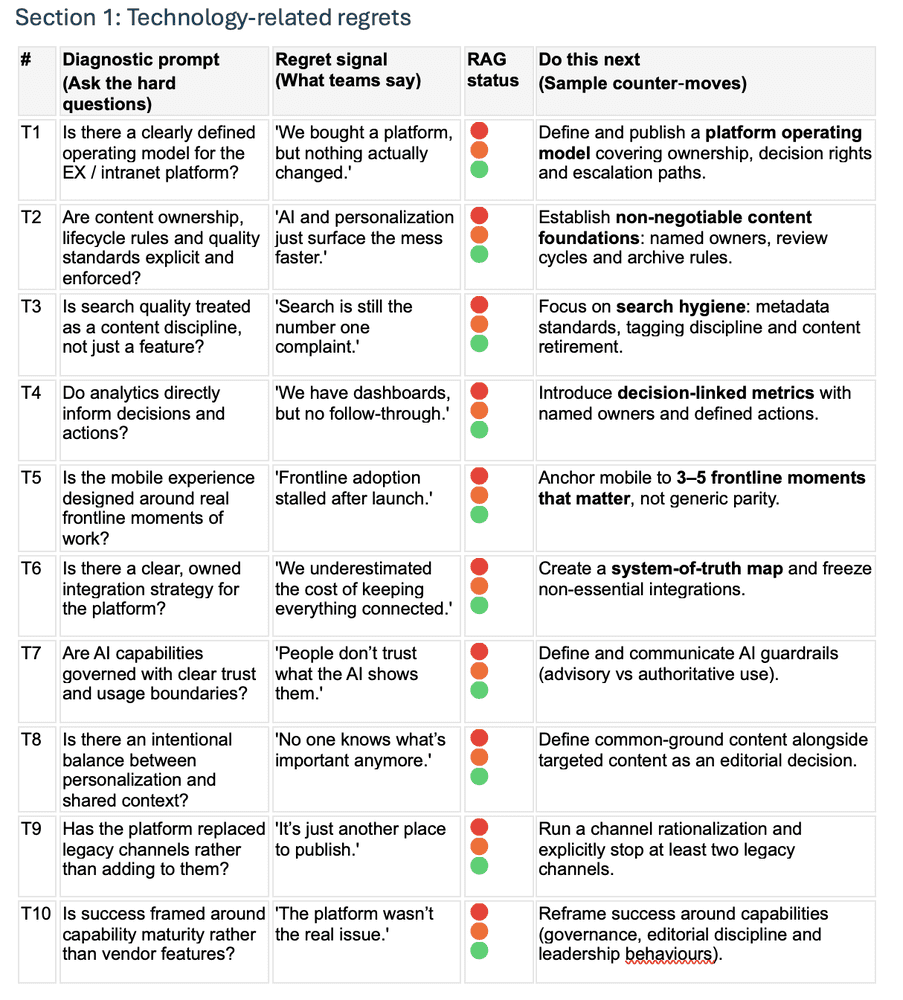
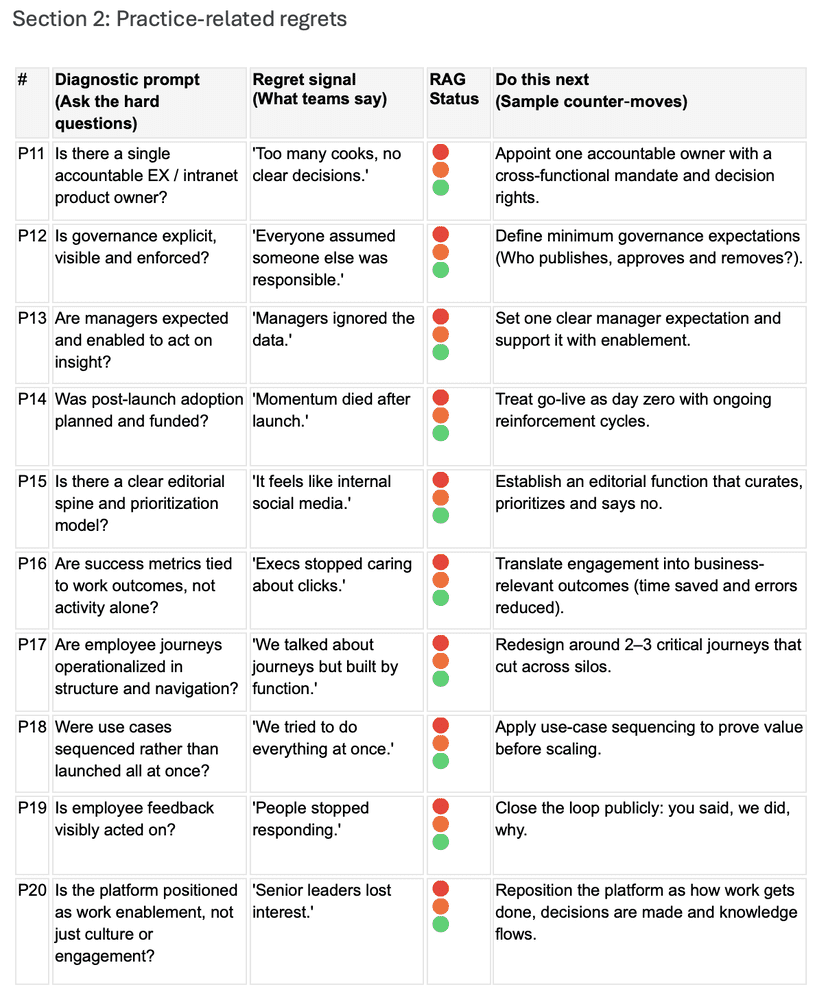
It is a Red, Amber, Green (RAG) diagnostic, designed for use 12 months after implementing an employee experience platform. It is split into two sections: 1) the technology regrets; and 2) the practice regrets. Because the truth is that most organizations do not fail on technology; they fail on practice – and the technology simply makes that failure more visible.
Before we get into the scorecard, one more reflection: if you are reading this a year after a major platform move and feeling a little bruised, you are not behind. You are simply at the part of the journey where the honeymoon ends and the operating model begins. And… that is where real leadership shows up.
What we are diagnosing
This diagnostic is not asking ‘Did you implement the platform?’ Rather, it is asking ‘Did you implement the conditions for the platform to matter?’.
In practice, this boils down to 20 questions: 10 focused on the technology decisions and 10 on the organizational practices that turn technology into outcomes.
Scoring guidance
Use the scoring guidance below consistently across all 20 diagnostic prompts:
- 🔴 Red: not in place or largely ad hoc, no clear owner.
- 🟠 Amber: partially in place or inconsistently applied.
- 🟢 Green: clearly defined, owned and routinely applied.
How to use this scorecard
🔴Red count: immediate risk and reset required.
🟠Amber clustering: priority capability themes (governance, leadership and content).
🟢Green gaps between 1 and 2: technology outpacing practice (or vice versa).
Now for the diagnostic: DWG EX Platform Regrets and Recovery Scorecard
For use 12 months after implementing an employee experience platform.
Note: For a working copy of this scorecard, get in touch via info@digitalworkplacegroup.com.
If the above section feels technical, here is the twist: it is the easy half. What your score is trying to tell you?
Note: For a working copy of this scorecard, get in touch via info@digitalworkplacegroup.com.
Because even when teams fix the technology side, the project can still wobble if practice does not catch up – which brings us to section 2.
Here is my She‑E‑O translation guide:
- A high Red (🔴) count does not mean you failed. It means you are operating without a shared contract for how this platform creates value.
- Clusters of Amber (🟠) reveal your priority themes: governance, leadership and content are the usual suspects.
- A mismatch between technology Greens (🟢) and practice Reds (🔴) is the classic pattern: your platform matured faster than your organization did.
And if you want a single line to take into your next steering group meeting, here it is:
An employee experience platform does not fix a fragmented digital workplace. It reveals it.
The strategic intent hiding inside all this
As a digital workplace leader, your job at month 12 is not to defend the implementation. Your job is to convert the implementation into a capability.
That requires three moves:
- Name the operating model.
- Build the editorial spine.
- Make decisions follow data.
Do that and the platform stops being a shiny object and becomes infrastructure. Ignore it and you will be back in 12 months, implementing yet another layer and wondering why the experience still feels stitched together.
A practical call to action
Stealing shamelessly from the pages of a Bridgerton script, I say… Dearest Gentle Reader… scratch that… Delete. Delete. Delete…
Hey Fellow Digital Workplace Warrior:
If you have made a major move to a new platform in the past year, try this:
- Score all 20 lines as Red, Amber or Green.
- Circle your top five Reds.
- Pick the single counter‑move that would convert each Red into Amber in the next 60–90 days.
- Publish those five moves as your ‘EX reset plan’ and give them owners.
The most interesting part of our work is not the technology. It is what happens when leaders stop asking ‘What did we buy?’ and start asking ‘What are we building?’.
That is the moment the regret turns into strategy. And that, fellow warriors, is the moment we smile like the Cheshire Cat and say, ‘Welcome to Wonderland, Alice!’.
Don’t journey alone
🔑If you are a DWG member and you would like a second set of eyes on your scoring, this is exactly the kind of conversation we love to facilitate in a safe, peer‑anchored and data-driven way. Just AskDWG.
🔒If you are not, that’s the moment we smile and say,’ Why journey alone when you can find the key in AskDWG’? Find out how to become a DWG member.
Categorised in: → Diary of a She-E-O