Why your digital workplace keeps hitting change fatigue
The uncomfortable truth
The nature of change in the workplace has, well, changed. While change is not new, the pace, impact and implications are very different from 10 or even 5 years ago. Change today feels like an onslaught. The digital workplace is in permanent beta. The ‘old’ way, where initiatives and technology were introduced, adopted and became ‘business as usual’, has morphed into a state in which change is discontinuous. What was new yesterday is already old today. Hello change fatigue.
Generative AI in the workplace became commonplace about 3 years ago, and it has evolved to the point where those initial models are now invalid. Tools evolve at a blinding pace: Microsoft introduced its Knowledge Agent less than a year ago, and today it already has a new name (AI in SharePoint) and a new AI provider (Anthropic). Teams and channels are sprawled across the enterprise, duplicated, uncontrolled. Abandoned. Just like the attempts to adopt them. The impact of this dizzying change reverberates across the organization. Leadership and employees lose sight of the sheer volume, cumulative impact and strategic value of the various initiatives underway. New projects are launched without awareness of existing, competing or failing initiatives. Eventually, cognitive fatigue, burnout and poor management of change lead to an organization unable to see the uncomfortable truth of its reality.
Change is inevitable. Change fatigue is not. Ultimately, it is not what you change, but how you do it that determines the organization’s response.
Change fatigue risks to the employee experience
One of the biggest risks and consequences of change fatigue is the deterioration of the employee experience (EX). The constant tech rollouts and new initiatives create scepticism, cynicism and mistrust. The mental demands on employees can be detrimental to their wellbeing, resulting in burnout, disengagement, time away from work and increased employee turnover. This is known as ‘technostress’.
EX and digital workplace leaders are now essential stewards of ‘change load’, i.e. the cumulative burden of transformation initiatives on employees. Because modern digital workplace leaders sit at the intersection of technology, HR and communication, they must curate the pace of change and act as filters to prevent change fatigue. They are uniquely positioned as change stewards because:
- They oversee the digital ecosystem and the systems which act as the primary interface between employees and transformation.
- They connect multiple stakeholders across key business functions, giving them a natural orchestration role.
- They own the digital employee experience. This allows them to detect early signals of change fatigue such as declining engagement, low tool adoption and workarounds.
Digital transformation success depends less on the number of technologies deployed and more on the organization’s capacity to absorb change. In other words, change agility is a key differentiator.
What is change agility in the digital workplace?
Change agility is the organization’s capacity to absorb new tools, processes and ways of working at a steady pace, while keeping employees informed, engaged and well. It is the combination of mindsets, relationships and systems that allows teams to sense and respond to change while sustaining wellbeing and performance.
DWG’s recent research report on change agility describes it as:
“…creating space to breathe amidst the urgency, to slow down just enough to see clearly, and then to act with purpose. In doing so, digital workplace teams become more than responders to disruption; they become architects of resilience and stewards of possibility.”
The DWG report describes change agility as three reinforcing capability layers:
- Personal, which focuses on individual mindset and behaviour (e.g. resilience, adaptability).
- Relational, which is about how teams collaborate and lead change (e.g. empowerment, trust).
- Strategic, which centres on the organizational sensing and response (e.g. foresight, agility).
Together, these create an organization that can continuously sense, interpret and respond to change without overwhelming people.
Organizations with change agility have several characteristics:
- They take smaller bets
Instead of taking on large, high-risk transformation projects, they make small, incremental changes. These changes iterate and evolve in real time, supporting strategic change agility.
- Faster feedback
Organizations collect signals quickly (data, analytics, employee feedback) and adjust accordingly. This ensures that change is continuously informed by evidence rather than assumptions.
- Co-creation with employees
Employees are actively involved in designing and shaping initiatives, rather than being passive recipients of change. This shifts from top-down programmes to shared ownership of change across the organization.
- Continuous improvement
Change is treated as an ongoing process of learning and adapting. Conversely, change agility is a permanent capability rather than a project or programme.
Change agility and traditional change management
It is not the case that change agility replaces traditional change management. Rather, it is an adaptation of traditional change management for the modern digital workplace, where change is constant rather than episodic.
Both change agility and change management focus on adoption and people, reducing resistance to change and governance. The difference is that change agility reflects the reality that digital workplaces operate in continuous transformation. Whereas traditional change management treats change as a project with a beginning and an end, the change agility model views change as ongoing and iterative. Traditional change management often focuses on large transformation initiatives, while change agility encourages iteration, experimentation and evolution. In traditional change management, each initiative is often managed independently whereas change agility recognizes that employees experience the cumulative impact of many changes at once.
In practice, most organizations combine both approaches: traditional change management provides structure, while change agility builds the organizational capability to continuously adapt. Traditional change management helps organizations deliver change successfully and change agility helps organizations to live successfully with constant change.
What change-agile digital workplaces have in common
Change-agile digital workplaces combine empowering leadership, iterative ways of working and adaptable employees so the organization can continuously sense and respond to change.
- Leadership patterns
In change-agile organizations, digital workplace leaders create the conditions for change rather than trying to control it. They display empathetic, trust-based leadership, underpinned by curiosity and learning. They practice distributed leadership and empower teams to initiate change, based on their own observations. Employees feel safe to challenge ideas, experiment and innovate. Leaders actively listen to feedback and signals from employees.
- Ways-of-working patterns
Change-agile organizations work differently. Experiments, pilots and prototypes are tested quickly and iterated. Analytics, employee feedback and external insights are used to monitor changes and quickly respond. Collaboration across functions, regions and hierarchies is the norm, and experimentation and learning are part of the culture.
- Employee patterns
Employees in change-agile organizations continuously learn, unlearn and relearn new skills. They are equipped to understand and use emerging technologies and are comfortable operating in ambiguity and adapting quickly. They participate in champion networks and help peers spread change across the organization. And they are invited to contribute ideas, provide feedback and experiment without fear of failure. Employees are treated as sensors, innovators and co-creators of change.
Using agile governance to deploy AI at EY
DWG’s change agility report describes how EY’s deployment of generative AI demonstrates change agility working in practice.
When generative AI began to emerge rapidly, many organizations were unsure how to respond. The EY team wanted to explore the potential of AI fast, equipping employees to use the technology while not taking any regulatory or reputational risks. Even before a strategy had been defined, a change-agile approach was adopted:
1. Guardrails, rather than rigid controls, were established
Nine ‘Responsible AI’ principles covering areas such as accountability, transparency, fairness and security were built.
This created clear governance boundaries while still allowing teams to experiment and move quickly.
2. Employee capability was invested in
EY ensured effective employee engagement with the technology by introducing AI training and certification programmes. This demonstrates personal change agility, building employees’ confidence and ability to adapt.
3. Experimentation was encouraged
Employees were encouraged to experiment with AI tools in their day-to-day work. An initiative called ‘Time Shift’ allowed staff to use time saved through AI to upskill, volunteer and improve work–life balance. This reinforced a culture of experimentation and continuous learning, which is key to change-agile environments.
4. They scaled what worked
Gradually, AI was embedded in internal operations and client-facing work. Rather than launching a single large AI transformation programme, EY created the conditions – governance, skills and experimentation – for continuous adaptation as the technology evolved.
How to get started: a simple self-check
Across the organizations examined in DWG’s recent change agility report, these patterns show that change agility is about building organizational habits, leadership behaviours and employee practices conducive to radical and rapid change.
But how do you know whether those patterns exist in your own organization? One way to start is by asking a few simple diagnostic questions.
A quick self-check: How change-agile is your digital workplace?
The report includes a self-assessment designed to help leaders reflect on how their organization approaches digital workplace change. Even without completing the full tool, a few simple questions can be revealing.
Consider these five prompts:
- When was the last time you stopped, redesigned or delayed a change because employees told you it wasn’t working?
- Do leaders actively model new digital tools and behaviours, or are employees expected to adopt them alone?
- How quickly can teams test and adapt new ways of working before rolling them out more broadly?
- Do employees have clear guidance on when to use which digital tools for collaboration, communication and knowledge sharing?
- Are employees treated as co-creators of the digital workplace or primarily as recipients of change?
These questions are about signals: how your organization listens, adapts and learns during change.
If some of these questions are difficult to answer (or the answer is ‘rarely’), it may indicate that change is still being delivered as a programme rather than embedded as an ongoing capability.
To get a fuller picture, read the research and download the self-assessment template. It’s a useful starting point for conversations with leaders, digital workplace teams and employees about how ready your organization really is for agility in change.
Download the free research
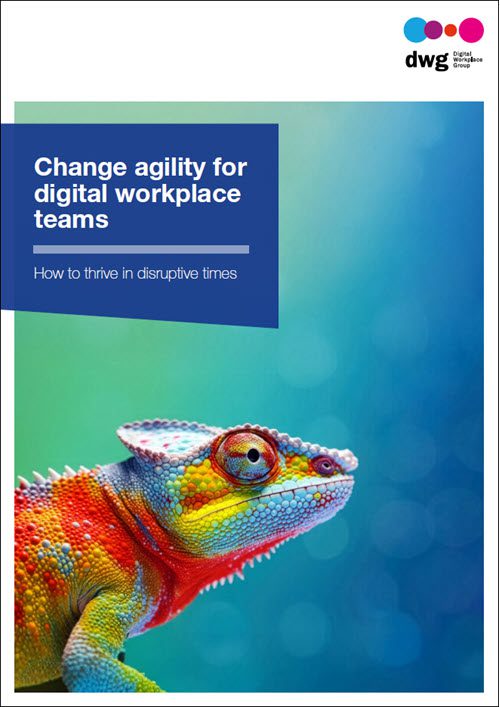
To minimise change fatigue and to understand how change-agile you and your organization are, download the full research report for free.
🔒 DWG members can access their copy of the research via the extranet. 🔒
For more digital workplace resources, DWG members have full access to this research, as well as exclusive articles, events, peer insights and a Research Library of 100+ reports covering key areas such as digital employee experience, AI readiness, strategy and governance, knowledge management, digital workplace transformation, change management, and more.
Contact us to learn how to gain access to this library via DWG membership.
Categorised in: Change management and adoption