Knowledge Management Systems
How a knowledge management system can transform your business efficiency
How a knowledge management system can transform your business efficiency
Discover how a knowledge management system can boost your business efficiency and streamline operations. Learn more about its key components and best practices.

Introduction to knowledge management
Most organizations already have more knowledge than they can realistically use. The challenge is making that knowledge easy to find, trust and apply in day-to-day work.
Employees spend a significant amount of time searching for information, recreating work that already exists, or relying on informal networks to get answers. At the same time, organizations are investing heavily in AI, expecting faster decisions and better outcomes. That expectation only holds if the underlying knowledge is accessible and reliable.
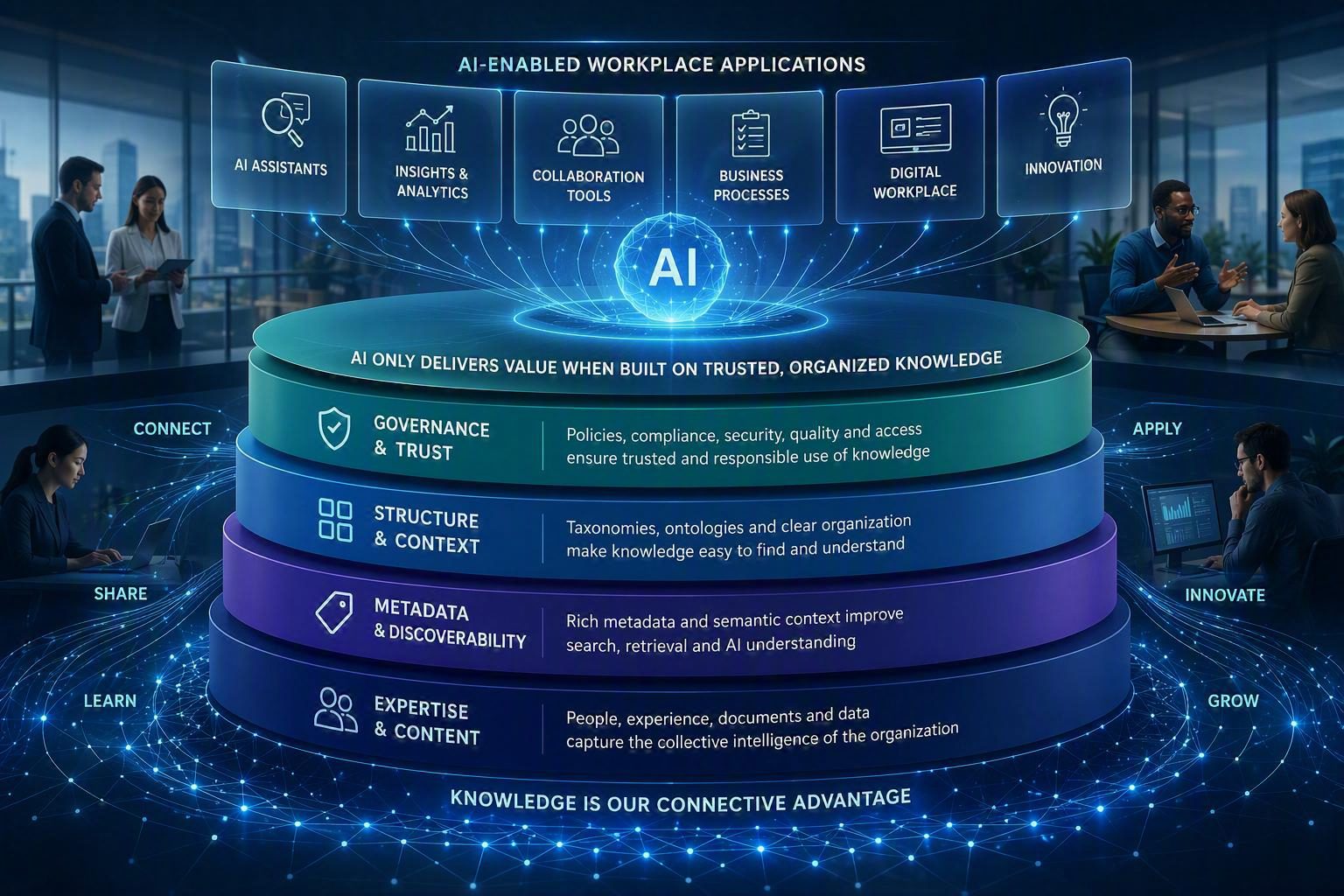
A well-designed knowledge management system (KMS) can play a central role, acting as the connective layer between content, people, processes and, increasingly, AI. In fact, AI has created a new imperative for knowledge management, as leaders recognize the need to identify the strategic and critical knowledge that gives the organization its competitive advantage.
This article looks at how knowledge management systems are evolving, what makes them effective in practice, and how organizations are approaching knowledge management in an AI-enabled workplace.
What is a knowledge management system?
The term ‘knowledge management system’ is often used to describe a platform or repository. In practice, it is much broader than that.
It is a holistic system that combines technology and organizational design to manage and orchestrate knowledge, not just data or information. A knowledge management system brings together:
- people who create, share and use knowledge
- processes that govern how knowledge is captured, maintained and reused
- technology that supports search, discovery and integration
- content that reflects what the organization knows and how it works.
The aim is to ensure that knowledge can be reused and applied, rather than lost or duplicated.
When organizations approach knowledge management systems in this way, they move beyond storing documents and start improving how work gets done.
What is the role of AI in knowledge management?
The growing use of AI in knowledge management has raised the stakes.
AI systems depend on enterprise knowledge to generate responses, recommend actions and support decisions. When that knowledge is inconsistent, outdated or hard to access, it directly affects the quality of AI outputs.
This is prompting many organizations to rethink how their knowledge management systems are structured and governed. Common shifts include:
- moving from large, static documents to smaller, reusable knowledge assets
- connecting knowledge across systems rather than centralizing everything in one place
- improving metadata and structure so knowledge can be retrieved and understood more easily
- strengthening governance to ensure accuracy and accountability.
AI can help scale access to knowledge, but it also exposes weaknesses in how knowledge is managed.

Some best practices for knowledge management
Across different industries, patterns are emerging in how effective knowledge management systems are designed and run.
Start with a clear view of what matters
Organizations that make progress in knowledge management start by identifying:
- which knowledge is critical to performance
- where employees struggle to find or apply knowledge
- how knowledge flows between teams and systems.
This clarity shapes the design of the knowledge management system and keeps it aligned to real business needs.
Focus on knowledge, not just content
Treating knowledge as a collection of documents tends to lead to clutter and duplication.
A more effective approach is to:
- define knowledge as reusable assets
- break content into manageable, structured units
- write and organize information so it can be easily reused in different contexts.
This becomes even more important in AI-enabled environments, where systems work with smaller pieces of information rather than long documents.
Encourage contribution and collaboration
A knowledge management system only works when people use it and contribute their ideas and expertise.
Organizations that see strong collaboration and contribution tend to:
- create a climate of open communication and trust between peers
- build knowledge-sharing into everyday workflows
- provide simple and intuitive knowledge tools
- support communities and peer networks
- recognize and reward contributions.
Many combine structured knowledge bases with informal collaboration, balancing efficiency with flexibility.
Treat governance as part of the system
An organization’s knowledge base is a living, organic body. This corpus of content can quickly become unwieldy if it is not tended to. Like a garden, it needs a ‘gardener’ to pluck out the weeds, cut back overgrowth, pull out dead plants and sow new seeds. In the past, it may have been tolerable to ignore governance of the knowledge base; doing so today is a fatal risk for the organization. As AI is increasingly prevalent, the quality of the knowledge base becomes more critical. If an organization’s knowledge content is redundant, outdated or trivial, then so will be the outputs delivered by AI knowledge tools.
Effective governance approaches include:
- assigning ownership for key knowledge assets
- defining review cycles and lifecycle stages
- setting standards for structure and metadata
- auditing and improving content over time.
In AI-driven environments, governance also helps ensure that outputs can be trusted and traced to reliable sources.
Build in continuous improvement
Knowledge management is ongoing work. Organizations monitor how their knowledge management systems are used and adjust over time.
This includes:
- identifying gaps or duplication
- retiring outdated content
- improving search and navigation
- expanding into new areas where knowledge is critical.

How do you implement a knowledge management system?
A structured approach to implementing knowledge management helps reduce risk and maintain momentum.
1. Understand the current state
Start by assessing how knowledge is currently managed, including:
- Where is knowledge stored?
- How do people find and use it?
- What are the main pain points?
This forms the basis for a clear business case.
2. Design the knowledge management system
Define:
- What counts as knowledge in your organization.
- Which knowledge assets are most important.
- How ownership and governance will work.
- How systems and tools will support access and reuse.
Design decisions are easier when they are anchored in real use cases.
3. Pilot and refine
In large organizations, it often makes sense to run a pilot before scaling a knowledge management system across the entire organization. This provides an opportunity to test the model, gather feedback and iterate before rolling it out at scale.
This allows teams to:
- Test structures and processes.
- Gather feedback from users.
- Improve the approach before scaling.
4. Scale and evolve
Once the approach is working, it can be extended to other areas of the organization.
Over time, the knowledge management system becomes embedded in how work is done, supported by ongoing governance and refinement.
Common challenges in knowledge management systems
Many of the challenges organizations face are familiar:
- Cultural barriers: Inevitably, change brings resistance. Employees may be reluctant to adopt the new system, and managers may not be on board.
- Technology barriers: Systems may be difficult to use or poorly integrated.
- Content problems: Content is outdated, duplicated or irrelevant, and knowledge is spread across multiple systems and formats.
Overcoming these barriers requires a coordinated focus on culture, people and change management.

What are the future trends for knowledge management?
Knowledge management systems are changing shape.
Organizations are moving towards environments where knowledge is:
- delivered in context, rather than searched for separately
- connected across platforms and workflows
- interpreted and summarized by AI
- maintained as structured, reusable assets.
Technologies such as semantic search, knowledge graphs and retrieval-augmented generation (RAG) are playing a role here, helping employees interact with knowledge more directly.
At the same time, expectations around governance, transparency and data quality are increasing, particularly where AI is involved.
Emerging intelligent capabilities in KMS
| Semantic search and knowledge graphs | Contextual, personalized retrieval, recommendations, rich linking |
| Retrieval-augmented generation (RAG) | Dynamic Q+A over a body of knowledge, self-adapting assistants |
| Predictive and adaptive systems | Real-time, personalized, behaviour-aware knowledge management |

Bringing it together
A knowledge management system supports far more than content storage. When it is designed well, it helps organizations to:
- reduce duplication and improve efficiency
- retain and reuse knowledge over time
- support better decision-making
- enable more effective use of AI.
The organizations making the most progress are those that treat knowledge management as an integral part of how work happens, supported by clear ownership, practical governance and systems that fit naturally into daily tasks.
For more digital workplace resources, DWG members have full access to exclusive articles, events, peer insights and a Research Library of 100+ reports covering key areas such as digital workplace management, AI readiness, strategy and governance, change management and more. Contact us to learn how to gain access to this library via DWG membership.

Knowledge management resources
- View all knowledge management articles
- Knowledge management best practices for 2025
- AI and knowledge management: The future of smarter work
- The resurrection of Knowledge Management in the digital workplace
- Why you can’t manage knowledge – and what to do instead
- The Findability Playbook
Access locked content 

Our members enjoy unlimited access to a library of resources, reports and many more exclusive benefits. If you’d like to view more digital workplace articles like these, please consider becoming a member!